A Call to Repent, to the Anglican Diocese of Montréal
Note: I stand behind all that I say here, but I do not speak for anyone else, including current or past employers. Jesus taught to me stand with those the powerful harm, and I am doing my best to do so.
From October 2015 until June 2023, I was an employee of the Anglican Diocese of Montréal, primarily as a university chaplain but also for a few years as an associate priest at Christ Church Cathedral.
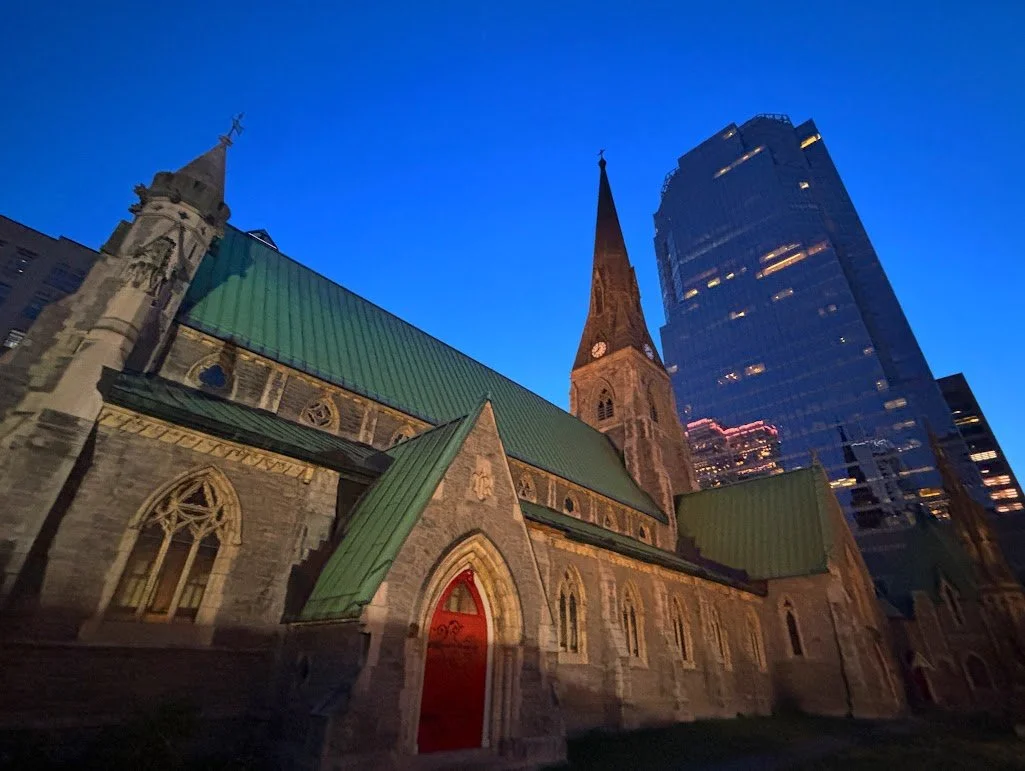
For eight years now, I have asked the Anglican Diocese of Montréal to do the right thing. For eight years now, multiple leaders have lied about, obstructed, and ignored pleas from many parties, of whom I am merely the loudest and most public. I am the loudest and most public not because I am the most harmed victim. I am not. I am the loudest and most public because I have the safety and privilege to be. That very safety and privilege is to me a moral and ethical imperative to action.
A priest formerly employed in the diocese was accused by multiple parties beginning at least eight years ago of abusive behaviours, including sexual harassment, financial malfeasance, and workplace bullying. I was never in the parish where these events were alleged to take place, but as the priest often targeted vulnerable young adults, and as I was a university chaplain and thus known in the diocese as the go-to person for the pastoral care of young adults, these people came to me.
Multiple victims confided in me their stories. These victims did not always even know one another, but they painted a similar picture. Naively, eight years ago, I believed when these concerns were relayed to the diocesan leaders, the victims would be respected and their stories would be heard, and the priest would face accountability. Quickly I learned that the previous executive archdeacon and bishop had no such plans.
One may ask why I am bringing up old stories. They are only old because of persistent inaction, because of a church structure that appears deliberately designed to fail its victims. We have never relented. The diocese, and of late the national Anglican Church, have been complicit in covering up and silencing victims and whistleblowers.
Victims of this priest lost employment and had ordination processes derailed while he continued in ministry and his parish was often treated as diocesan favourite, showered with financial subsidies in the face of credible concerns about dishonest accounting and public promotion in the face of credible concerns about abusive leadership. As a whistleblower to diocesan leadership, I was physically attacked by this priest at a diocesan meeting, the bishop and executive archdeacon ignored my letter of complaint against the priest for that for over a month, only meeting with me when I wrote again saying I would file a safe church against them for inaction. They told that priest to simply leave me alone, which the priest did do, but no further steps were taken. In the coming years I continuously faced worsening work conditions, including reduction in hours, and my speaking out for justice was used a pretext for criticizing my job performance.
Throughout this time, the diocese refused, as far as I could see, to do anything about the priest whose behaviours instigated the crisis. It is possible ineffective actions were being taken that I was not informed about. What I do for certain is as many of six of his victims—victims whose complaints were known to the diocese—were never offered information, pastoral care, or reconciliation.
The victims and whistleblowers were continuously subjected to a mix of silent treatment and ever moving targets of procedures. The diocese was never clear about the correct procedure, only insistent that whatever approach we took was wrong. We spoke directly to the bishop. To the human resources staff. To the executive archdeacon. To the Montréal police. We eventually spoke to other vulnerable people. I was called in to be rebuked for my actions. A seminarian was rebuked for speaking out to classmates. The diocese engaged in unabashed victim blaming, laying blame for any scandal at those harmed, not the one doing the harm.
Three years ago, I accepted employment with another denomination. The Anglican Diocese of Montréal simply would not provide me with stable full-time employment, and as a single father I needed both full-time work and to remain in Montréal.
I would note I did so with the bishop’s explicit ecclesiastical permission, a necessary formality to maintain status as a licenced Anglican priest. (The university chaplaincy position was an ecumenical shared ministry and I had always had clergy standing in multiple traditions.)
Indeed, even while in full-time employment of another denomination, I served as a volunteer associate priest of a local Anglican parish, frequently providing pulpit supply and liturgical leadership for no pay. The bishop eventually notified the parish priest with whom I served that I no longer had a licence to officiate in the diocese. Unceremoniously, with no thanks, I ceased even volunteer work with the diocese. To date, the diocese has still never contacted me about the reasoning for my loss of licence. The diocese has ignored multiple communications on this topic for three years.
About one year ago, this all came to the fore again as the diocese held an election for a new bishop. The priest accused of abuse was advanced as a candidate for bishop. His reputation was the most open of diocesan secrets, and multiple members of the search committee resigned in protest when the diocese insisted he had to be kept on the ballot.
Thanks be to God, he was not elected. The victims and I had hopes that under new leadership, the diocese would turn the page and start treating victims better. At first, this seemed promising. The diocese announced the creation of an ombudsperson to receive complaints and help guide them along. After years of murky complaint procedures, and a hierarchy committed to all claiming any given issue was not their portfolio of responsibility, this seemed like the change for which we had prayed.
Alas, it was a performative lie. When I contacted the new ombudsperson, the new executive archdeacon, and the new bishop, the ombudsperson and executive archdeacon both told me that my concerns were not their responsibility. And the bishop simply never has responded.
Eventually the priest about whom we all were concerned was mysteriously removed from his position. This appeared to be good news. I recontacted the new ombudsperson, the new executive archdeacon, and the new bishop, and expressed that this news was a relief for those this priest had hurt, but that the diocese still owed his victims communication and care. I made no assumptions about what that would look like. What I do not accept is sweeping matters under the rug and refusing to acknowledge that for eight years this abusive priest and his enabling diocesan staff made generous salaries while his victims lost employment, left ordination processes, and left the denomination or religion altogether or even the country. Until recent months the only priest in the diocese who had been punished was me, the priest to whom victims confided, the priest who naively thought the bishop would be a good person who cared about her flock.
I would note I am not naming the accused priest. He deserves some sort of due process. The diocese, however, denied him that for all this time and denied his victims that. This is about the diocese’s actions. It is not even about the previous leadership, as corrupt as I insist they were, but the current leadership, whose refusal to care for people is deeply shocking and disappointing to me.
In May, I wrote to the new ombudsperson, the new executive archdeacon, and the new bishop again. I wrote to them collectively, acknowledging in their ever-updating of procedures that I did not know whose mandate covered which responsibilities, but asking for any of them to reply to me so we could meet, so I could outline the concerns I have on behalf of the victims, and help them do what is pastorally and morally right. They simply never responded.
At the beginning of June, I escalated my concerns. I wrote to the archbishop (the leader of the next higher level of Anglican governance, confusingly called the province of Canada, a territory larger than any province but smaller than all of Canada) as well as the national church office. The archbishop, to his credit, quickly confirmed receipt of my concerns. The national office, unsurprisingly, denied any role in the issue, but even that was at least a response.
However, it has been more than a month of silence yet again. One more level of church governance, one more attempt to get the Anglican Church of Canada to care about those it has harmed, one more example of it trying to silence its victims with inaction.
No.
We say no.
We say we do not accept that.
I asked for a meeting. I, an ordained Anglican priest, who has been denied any due process in my own story simply asked for a meeting so I could share with the bishop and his right-hand executive archdeacon the story of faithful people harmed in their diocese so they would have the opportunity to care for them.
I could not be more profoundly disappointed to say that the The Right Reverend Dr. Victor David Mbuyi Bipungu and the Venerable Dr. Deborah Meister have abdicated their sacred responsibility as pastors, and believe silence and inaction are acceptable.
We must tell them we do not accept that. We expected better of them. God expects better of them.
I am calling them to repent. I ask you to call them to repent, too.
With due respect for the multitude of responsibilities they face in their new roles, one could imagine they are simply too preoccupied to handle the petty grievances of people whose entire livelihoods were destroyed in this saga. Yet, they openly and publicly claim to care, and that hypocrisy must be called out.
In his bishop’s charge, an annual state-of-diocese address, the bishop performed the role of a caring pastor. Such an image is vapid and disingenuous in the face of his real behaviour.
He said:
“No renewal is possible without trust. Our Diocese remains committed to strengthening safeguarding practices and ensuring that the Church is a safe place for all people, especially children, youth, and vulnerable adults. We must continue the difficult but necessary work of accountability, transparency, and healing.”
“A healthy Church is not only spiritually vibrant; it is also a community where people feel protected, respected, heard, and treated with fairness and dignity. This commitment requires more than policies on paper. It calls us to cultivate a diocesan culture marked by responsibility, transparency, compassion, and due process.”
Where do we see that in the story of the past eight years, the last year of which has been on his watch?
There has been no transparency, compassion, or due process.
Most egregiously, while never contacting me, he pre-emptively warned the diocesan faithful against me:
‘’Social media platforms can easily become places where frustration, accusation, speculation, and personal grievances are amplified publicly before facts are properly established. I call you to resist a culture of gossip, public shaming, and second-hand accusations. We must not allow Facebook commentary, anonymous online discussions, or rumours to become substitutes for proper pastoral and disciplinary processes. While concerns must always be taken seriously, they must also be handled responsibly. This does not mean silencing legitimate concerns. Rather, it means encouraging concerns to be brought forward through appropriate channels where they can be properly heard, examined, and addressed with integrity and fairness.’’
This is all eloquent dishonesty.
The diocese has no proper pastoral and disciplinary processes. The diocese relentlessly silences concerns. It has handled little seriously or responsibly. How dare the bishop say he is encouraging concerns when he does not respond to them at all.
I am not gossiping. I am not anonymous. I am not second hand.
Ignore me, dislike me, disbelieve me, even. But I am not hiding. The bishop is, though. The Province of Canada is. The Anglican Church of Canada is.
In the end, I agree with the bishop’s words. The bishop, however, does not agree with himself. Integrity and fairness are sorely missing.
As far as public shaming? Yes. I am taking the truth into the light, that it may set the church free. I have tried all possible internal processes. They do not even exist as far as I can tell. They are dead ends to unlistening ears.
I am sharing, in fact, because of my profound belief in the goodness of Canadian Anglicans, though my faith in the goodness of its leadership is weak. I believe you collectively have the power to tell the church you do not accept this story as the way your church behaves. You do not accept that this how it spends the money you donate. You do not accept this happening in your name.
Because indeed this post never needed to be written if only—ever in the last eight years a bishop of Montréal cared about the people their diocese has hurt enough to listen.